1
/
of
1
NAL VON MINDEN SRL
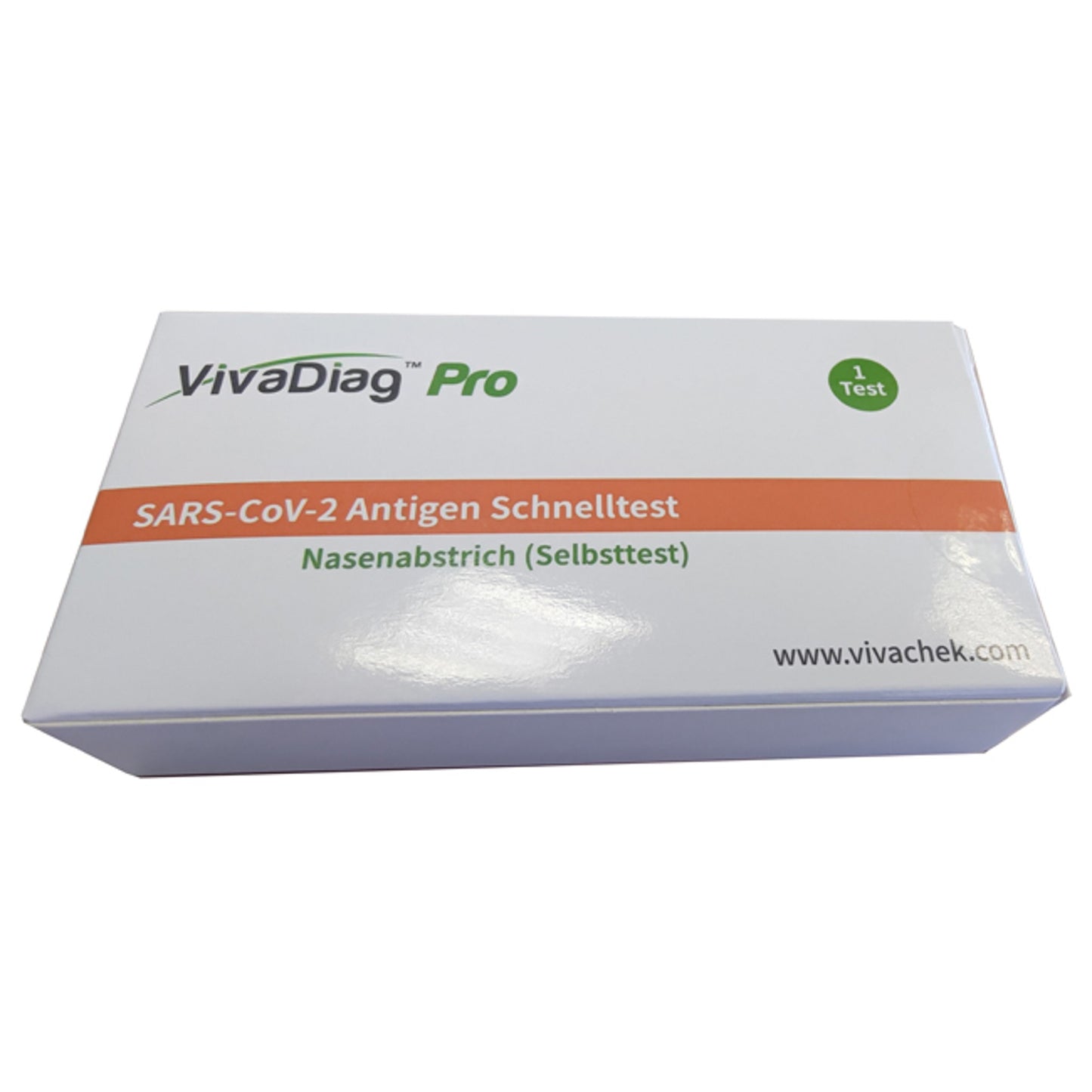
Covid-19 Vivadiag Pro Rapid Antigen Test Self-Diagnosis Qualitative Determination of SARS-CoV-2 Antigens in Nasal/Nasopharyngeal/Oropharyngeal Swabs by Immunochromatography
Covid-19 Vivadiag Pro Rapid Antigen Test Self-Diagnosis Qualitative Determination of SARS-CoV-2 Antigens in Nasal/Nasopharyngeal/Oropharyngeal Swabs by Immunochromatography
Regular price
€12,75 EUR
Regular price
€15,00 EUR
Sale price
€12,75 EUR
Taxes included.
Shipping calculated at checkout.
Quantity
Couldn't load pickup availability
MINSAN: 985002334
EAN: 6970221761872
DITTA: NAL VON MINDEN SRL
VivaDiag Pro
Rapid Test for SARS-CoV-2 Ag
Description
Rapid test for the rapid and qualitative detection of the SARS-CoV-2 nucleocapsid protein antigen in humans.
The test is for in vitro diagnostic use only. It is indicated for self-testing. It only provides an initial screening test result. Alternative, more specific diagnostic methods (molecular diagnosis and/or CT) should be performed to confirm SARS-CoV-2 infection. The decision on the diagnostic procedure rests with the physician.
The test is based on immunochromatography technology. Each test device features a SARS-CoV-2 antibody line, identified as the detection line (T line), and an anti-mouse IgG antibody line identified as the quality control line (C line).
When the extracted sample is added to the sample well, it will react with the labeled antibody to form a complex; the mixture will then migrate through the membrane by capillary action and interact with the coated anti-SARS-CoV-2 antibody on the detection line.
If the sample contains the SARS-CoV-2 antigen, the detection line will appear red, indicating that the SARS-CoV-2 antigen is positive. Otherwise, the test result will be negative.
The test device also contains a quality control line (C line) which must turn red to confirm that the test was performed correctly and is valid. If the quality control line (C line) does not appear, the test result will be invalid, even if the detection line is present.
The test is intended for home use with self-collected nasal swab samples in individuals aged between 16 and 69 years. Sample collection and test execution by individuals under 16 and over 69 should be done under adult supervision. For individuals unable to perform the test themselves, the test should be conducted by legal guardians; ill/disabled individuals (including those with visual impairments) should be assisted during the test.
Instructions for use
Sample collection and handling
Wash hands with soap and water or use hand sanitizer.
Open the swab package at the stick end and remove the swab. Do not touch the swab tip.
Insert the sterile swab into one nostril. Ensure that the entire tip of the swab has been inserted into the nostril (approximately 1.5 cm deep). Rotate the swab 5 times against the mucous membrane inside the nostril to ensure that both mucus and cells are collected. Repeat this process for the other nostril to collect an adequate sample from both nasal cavities (using the same swab).
Samples should be tested as soon as possible after collection (it is recommended to test them within 5 minutes of collection).
Testing procedure
Allow test devices and extraction solution to equilibrate to 15-30 °C before testing.
Open the extraction solution (in the sealed tube). Insert the swab with the collected sample into the extraction tube containing the extraction solution. Rotate the swab 5 times, pressing the swab tip against the bottom and sides of the tube. Remove the swab by pressing it against the sides of the tube to extract the liquid from the swab. Try to extract as much liquid as possible.
Insert the dropper tip onto the tube. Remove a test device from its sealed pouch and place it on a clean, flat surface.
Apply 3 drops of the extracted sample into the sample well on the test cassette. Avoid bubble formation during this operation.
Read the test result after 15 minutes. Do not read the result after 20 minutes.
Interpretation of results
POSITIVE: both the quality control line (C) and the detection line (T) are displayed. Any shade of color on the test line (T) should be considered a positive result.
A positive result indicates suspected COVID-19 infection. In case of suspicion, immediately contact your doctor/general practitioner or local healthcare facility. Follow local guidelines for self-isolation and subsequently perform a confirmatory PCR test.
NEGATIVE: only the quality control line (C) is displayed; the detection line (T) does not appear.
In case of a negative result, continue to follow all applicable rules regarding contact with others and protective measures. Infection may still be present even if the test result is negative.
In case of suspicion, as the coronavirus cannot be accurately detected at all stages of infection, immediately contact your doctor/general practitioner or local healthcare facility.
INVALID: the quality control line (C) does not appear, indicating that the test is invalid, regardless of whether the detection line appears or not.
Incorrect test execution may be the cause of the control line (C) not appearing. Collect a new sample and perform another test with a new device. If test results continue to be invalid, immediately contact your doctor/general practitioner or local healthcare facility.
Warnings
For in vitro diagnostic use only, and for self-testing.
Test results should not be used as the sole basis for diagnosing or excluding SARS-CoV-2 infection or for informing on infection status. Do not make any medical decisions without first consulting your doctor.
Negative results do not rule out SARS-CoV-2 infection, particularly in those who have been in contact with the virus. Follow-up molecular diagnostic and/or CT testing should be considered to rule out infection in these individuals.
Positive results may be due to an existing infection with SARS-coronavirus strains. Follow-up molecular diagnostic and/or CT testing should be considered to confirm the test result.
Negative results may occur if the antigen level in the sample is below the test's detection limit.
Inaccurate results may occur due to visibly bloody or excessively viscous samples, insufficient sample volume, or bubble formation during application.
Do not use damaged or unusable swabs.
Individuals with color vision deficiencies may not be able to adequately interpret test results.
Keep out of reach of children.
Use the test device within 60 minutes of opening the foil pouch.
Do not perform the test in direct sunlight. Do not use the test device if it has been exposed to household cleaning products (especially bleach).
Keep foreign substances away from the test device during the testing procedure.
Please take necessary safety measures (e.g., face mask, gloves) when performing tests for other people.
Used test components must be disposed of in accordance with local requirements, and can be placed in a tightly sealed bag and disposed of as household waste.
Further molecular diagnostic and/or CT testing is recommended to identify the actual physical situation.
Do not open the test device's foil pouch, exposing it to the environment, until you are ready for immediate use.
Do not use damaged test devices or materials.
Do not reuse the test device.
Handle the extraction solution with care; do not touch eyes or skin. In case of contact with eyes or skin, wash thoroughly with water.
Do not use the test kit beyond the expiration date.
Follow the package insert for accurate results.
Wash hands thoroughly after handling and wash hands before sample collection and test performance.
The test does not determine the etiology of respiratory infection caused by microorganisms other than the SARS-CoV-2 virus.
The accuracy of the test depends on the quality of the sample collected with the swab. False negative results may occur if the sample is not collected adequately.
Failure to follow the test procedure may negatively impact test performance and/or invalidate the result.
Storage
Store the test kit in a dry place between 2-30 °C. Keep away from light. Exposure to temperatures and/or humidity outside the specified limits may cause inaccurate results. Do not freeze.
Shelf life of unopened packaging: 24 months.
Format
The kit contains:
- test device;
- extraction solution (in sealed tube);
- tube tip;
- sterile swab;
- instruction leaflet.
Bibliography
1. Coronaviridae Study Group of the International Committee on Taxonomy of Viruses. The species severe acute respiratory syndrome-related coronavirus: classifying 2019-nCoV and naming it SARS-CoV-2 [J]. Nature Microbiology, 5, 536-544 (2020).
2. Perlman, S. Netland, J. Coronaviruses post-SARS: update on replication and pathogenesis. Nature Reviews Microbiology 7, 439-450, doi: 10.1038/nrmicro2147 (2009).
3. McCarron, MM, et al. Detection of Phencyclidine Usage by Radioimmunoassay of Saliva. J Anal Tox.1984 Sep-Oct.; 8 (5), pp 197-201.
4. B. Korber et al. Tracking Changes in SARS-CoV-2 Spike: Evidence that D614G Increases Infectivity of the COVID-19 Virus. Cell, vol. 182, no. 4, pp. 812-827.e19, Aug. 2020, doi: 10.1016/j.cell.2020.06.043.
5. Investigation of novel SARS-CoV-2 variant: Variant of Concern 202012/01, GOV.UK.
6. New SARS-CoV-2 variant, GOV.UK.
7. D. C. Dinesh et al. Structural basis of RNA recognition by the SARS-CoV-2 nucleocapsid phosphoprotein. PLoS Pathog, vol. 16, no. 12, p. e1009100, Dec. 2020, doi: 10.1371/journal.ppat.1009100.
8. J. Mariën et al. Evaluating SARS-CoV-2 spike and nucleocapsid proteins as targets for antibody detection in severe and mild COVID-19 cases using a Luminex bead-based assay. Journal of Virological Methods, vol. 288, p. 114025, Feb. 2021, doi: 10.1016/j.jviromet.2020.114025.
Code. VCD16-10-013
Rapid test for the rapid and qualitative detection of the SARS-CoV-2 nucleocapsid protein antigen in humans.
The test is for in vitro diagnostic use only. It is indicated for self-testing. It only provides an initial screening test result. Alternative, more specific diagnostic methods (molecular diagnosis and/or CT) should be performed to confirm SARS-CoV-2 infection. The decision on the diagnostic procedure rests with the physician.
The test is based on immunochromatography technology. Each test device features a SARS-CoV-2 antibody line, identified as the detection line (T line), and an anti-mouse IgG antibody line identified as the quality control line (C line).
When the extracted sample is added to the sample well, it will react with the labeled antibody to form a complex; the mixture will then migrate through the membrane by capillary action and interact with the coated anti-SARS-CoV-2 antibody on the detection line.
If the sample contains the SARS-CoV-2 antigen, the detection line will appear red, indicating that the SARS-CoV-2 antigen is positive. Otherwise, the test result will be negative.
The test device also contains a quality control line (C line) which must turn red to confirm that the test was performed correctly and is valid. If the quality control line (C line) does not appear, the test result will be invalid, even if the detection line is present.
The test is intended for home use with self-collected nasal swab samples in individuals aged between 16 and 69 years. Sample collection and test execution by individuals under 16 and over 69 should be done under adult supervision. For individuals unable to perform the test themselves, the test should be conducted by legal guardians; ill/disabled individuals (including those with visual impairments) should be assisted during the test.
Instructions for use
Sample collection and handling
Wash hands with soap and water or use hand sanitizer.
Open the swab package at the stick end and remove the swab. Do not touch the swab tip.
Insert the sterile swab into one nostril. Ensure that the entire tip of the swab has been inserted into the nostril (approximately 1.5 cm deep). Rotate the swab 5 times against the mucous membrane inside the nostril to ensure that both mucus and cells are collected. Repeat this process for the other nostril to collect an adequate sample from both nasal cavities (using the same swab).
Samples should be tested as soon as possible after collection (it is recommended to test them within 5 minutes of collection).
Testing procedure
Allow test devices and extraction solution to equilibrate to 15-30 °C before testing.
Open the extraction solution (in the sealed tube). Insert the swab with the collected sample into the extraction tube containing the extraction solution. Rotate the swab 5 times, pressing the swab tip against the bottom and sides of the tube. Remove the swab by pressing it against the sides of the tube to extract the liquid from the swab. Try to extract as much liquid as possible.
Insert the dropper tip onto the tube. Remove a test device from its sealed pouch and place it on a clean, flat surface.
Apply 3 drops of the extracted sample into the sample well on the test cassette. Avoid bubble formation during this operation.
Read the test result after 15 minutes. Do not read the result after 20 minutes.
Interpretation of results
POSITIVE: both the quality control line (C) and the detection line (T) are displayed. Any shade of color on the test line (T) should be considered a positive result.
A positive result indicates suspected COVID-19 infection. In case of suspicion, immediately contact your doctor/general practitioner or local healthcare facility. Follow local guidelines for self-isolation and subsequently perform a confirmatory PCR test.
NEGATIVE: only the quality control line (C) is displayed; the detection line (T) does not appear.
In case of a negative result, continue to follow all applicable rules regarding contact with others and protective measures. Infection may still be present even if the test result is negative.
In case of suspicion, as the coronavirus cannot be accurately detected at all stages of infection, immediately contact your doctor/general practitioner or local healthcare facility.
INVALID: the quality control line (C) does not appear, indicating that the test is invalid, regardless of whether the detection line appears or not.
Incorrect test execution may be the cause of the control line (C) not appearing. Collect a new sample and perform another test with a new device. If test results continue to be invalid, immediately contact your doctor/general practitioner or local healthcare facility.
Warnings
For in vitro diagnostic use only, and for self-testing.
Test results should not be used as the sole basis for diagnosing or excluding SARS-CoV-2 infection or for informing on infection status. Do not make any medical decisions without first consulting your doctor.
Negative results do not rule out SARS-CoV-2 infection, particularly in those who have been in contact with the virus. Follow-up molecular diagnostic and/or CT testing should be considered to rule out infection in these individuals.
Positive results may be due to an existing infection with SARS-coronavirus strains. Follow-up molecular diagnostic and/or CT testing should be considered to confirm the test result.
Negative results may occur if the antigen level in the sample is below the test's detection limit.
Inaccurate results may occur due to visibly bloody or excessively viscous samples, insufficient sample volume, or bubble formation during application.
Do not use damaged or unusable swabs.
Individuals with color vision deficiencies may not be able to adequately interpret test results.
Keep out of reach of children.
Use the test device within 60 minutes of opening the foil pouch.
Do not perform the test in direct sunlight. Do not use the test device if it has been exposed to household cleaning products (especially bleach).
Keep foreign substances away from the test device during the testing procedure.
Please take necessary safety measures (e.g., face mask, gloves) when performing tests for other people.
Used test components must be disposed of in accordance with local requirements, and can be placed in a tightly sealed bag and disposed of as household waste.
Further molecular diagnostic and/or CT testing is recommended to identify the actual physical situation.
Do not open the test device's foil pouch, exposing it to the environment, until you are ready for immediate use.
Do not use damaged test devices or materials.
Do not reuse the test device.
Handle the extraction solution with care; do not touch eyes or skin. In case of contact with eyes or skin, wash thoroughly with water.
Do not use the test kit beyond the expiration date.
Follow the package insert for accurate results.
Wash hands thoroughly after handling and wash hands before sample collection and test performance.
The test does not determine the etiology of respiratory infection caused by microorganisms other than the SARS-CoV-2 virus.
The accuracy of the test depends on the quality of the sample collected with the swab. False negative results may occur if the sample is not collected adequately.
Failure to follow the test procedure may negatively impact test performance and/or invalidate the result.
Storage
Store the test kit in a dry place between 2-30 °C. Keep away from light. Exposure to temperatures and/or humidity outside the specified limits may cause inaccurate results. Do not freeze.
Shelf life of unopened packaging: 24 months.
Format
The kit contains:
- test device;
- extraction solution (in sealed tube);
- tube tip;
- sterile swab;
- instruction leaflet.
Bibliography
1. Coronaviridae Study Group of the International Committee on Taxonomy of Viruses. The species severe acute respiratory syndrome-related coronavirus: classifying 2019-nCoV and naming it SARS-CoV-2 [J]. Nature Microbiology, 5, 536-544 (2020).
2. Perlman, S. Netland, J. Coronaviruses post-SARS: update on replication and pathogenesis. Nature Reviews Microbiology 7, 439-450, doi: 10.1038/nrmicro2147 (2009).
3. McCarron, MM, et al. Detection of Phencyclidine Usage by Radioimmunoassay of Saliva. J Anal Tox.1984 Sep-Oct.; 8 (5), pp 197-201.
4. B. Korber et al. Tracking Changes in SARS-CoV-2 Spike: Evidence that D614G Increases Infectivity of the COVID-19 Virus. Cell, vol. 182, no. 4, pp. 812-827.e19, Aug. 2020, doi: 10.1016/j.cell.2020.06.043.
5. Investigation of novel SARS-CoV-2 variant: Variant of Concern 202012/01, GOV.UK.
6. New SARS-CoV-2 variant, GOV.UK.
7. D. C. Dinesh et al. Structural basis of RNA recognition by the SARS-CoV-2 nucleocapsid phosphoprotein. PLoS Pathog, vol. 16, no. 12, p. e1009100, Dec. 2020, doi: 10.1371/journal.ppat.1009100.
8. J. Mariën et al. Evaluating SARS-CoV-2 spike and nucleocapsid proteins as targets for antibody detection in severe and mild COVID-19 cases using a Luminex bead-based assay. Journal of Virological Methods, vol. 288, p. 114025, Feb. 2021, doi: 10.1016/j.jviromet.2020.114025.
Code. VCD16-10-013
Share