1
/
of
1
NEVIA BIOTECH SRL
COVID-19 Flowflex Rapid Antigen Test Qualitative Determination of SARS-CoV-2 Antigens in Nasal/Saliva Swabs by Immunochromatography Professional Use
COVID-19 Flowflex Rapid Antigen Test Qualitative Determination of SARS-CoV-2 Antigens in Nasal/Saliva Swabs by Immunochromatography Professional Use
Regular price
€15,00 EUR
Regular price
Sale price
€15,00 EUR
Taxes included.
Shipping calculated at checkout.
Quantity
Couldn't load pickup availability
MINSAN: 982504918
EAN: 6921756492496
DITTA: NEVIA BIOTECH SRL
Flowflex
SARS-CoV-2 Rapid Antigen Test
(Nasal/Saliva)
Description
A lateral flow chromatographic immunoassay for the qualitative detection of SARS-CoV-2 virus nucleocapsid protein antigen, in nasal swab or saliva samples, collected directly from individuals with suspected COVID-19 infection by their physician, within the first seven days of symptom onset.
The test can be used to analyze samples from asymptomatic individuals.
It does not distinguish between SARS-CoV and SARS-CoV-2.
When extracted samples are processed and dispensed into the test cassette, SARS-CoV-2 antigens, if present in the sample, react with particles coated with anti-SARS-CoV-2 antibodies, which are present on the test line (T). The mixture then migrates through the membrane by capillary action. The conjugated antigen complexes migrate through the test strip to the reaction area and are captured by a line of bound antibodies on the membrane. Test results are interpreted visually after 15 and no later than 30 minutes based on the presence or absence of visible colored lines.
As an exclusive procedural control, a colored line always appears in the control line region (C), indicating that the correct sample volume has been added and that proper membrane wetting has occurred.
A positive result indicates the presence of SARS-CoV-2 nucleocapsid antigen. This antigen is generally detectable in upper respiratory tract samples during the acute phase of infection. As noted, positive results indicate the presence of viral antigens, but clinical correlation with patient history and other diagnostic information is necessary to determine infection status. Positive results do not rule out bacterial infections or co-infections with other viruses. The detected agent may not be the definitive cause of the disease.
Negative results, in patients with symptoms beyond seven days, should be treated as presumptive negatives and confirmed with a molecular test for proper patient management. Negative results do not rule out SARS-CoV-2 infection and should not be used as the sole reference for treatment or patient management decisions, including decisions on which to base the clinical approach to infection. Negative results should be considered in the context of the patient's recent exposures, medical history, and the presence of clinical signs and symptoms consistent with COVID-19.
The test is intended for use by trained clinical laboratory personnel and qualified healthcare professionals at care facilities.
The SARS-CoV-2 Rapid Antigen Test is intended to be used as an aid in the diagnosis of SARS-CoV-2 infection.
How to use
The test must be performed immediately after sample collection, or at most within one (1) hour of sample collection, provided it is stored at room temperature (15-30°C).
Nasal swab sample collection can be performed by a professional or by oneself, but always under the supervision of a healthcare professional.
For children under 12 years of age, sample collection must be performed by a healthcare professional.
Children aged 12 to 17 must be supervised by adults if they collect the nasal sample themselves.
Adults (18 years and older) can perform nasal sample collection independently.
Follow local guidelines for sample collection by children.
How to collect an anterior nasal sample with a swab:
Carefully insert one of the disposable nasal swabs included in the kit into one nostril. Gently rotating it, push the swab no more than 2.5 cm (1 inch) into the nose from the tip of the nostril. Swab the cotton tip of the nasal swab on the inner surface of the nostril (mucosa) with rotational movements, both clockwise and counter-clockwise, for five consecutive times. Using the same nasal swab, repeat the procedure in the other nostril to ensure that an adequate sample is collected from both nasal cavities. Remove the swab from the nasal cavity. The sample is now ready for preparation using the tubes containing the extraction buffer solution.
How to collect a saliva sample:
Do not eat, drink, smoke, chew gum, or brush your teeth 30 minutes before collecting a saliva sample.
Before collecting a saliva sample, gently massage your cheeks for 15-30 seconds. Place your tongue against the roots of your lower teeth and allow saliva to collect in that area.
Insert a disposable cotton swab (included in the KIT) into your mouth and hold it for at least 30 seconds, until the tip of the swab is completely saturated with saliva.
Alternatively, saliva can be collected by carefully spitting into the saliva collection container included in the KIT.
When using the saliva collection container to collect saliva, immerse the absorbent tip of the disposable swab into the collection container until the tip of the swab is completely saturated with saliva.
Note: False negative results may occur if the swab is not completely saturated with saliva.
Allow the sample and extraction buffer solution to reach room temperature (15-30°C) before performing the test.
Use one tube containing the extraction buffer solution for each sample to be tested and label each tube appropriately. Remove the aluminum foil from the top end of the tube containing the extraction buffer solution. Insert the swab into the tube and shake for 30 seconds. Then rotate the swab at least 5 times, squeezing the sides of the tube tightly. Be careful not to spray the contents out of the tube. Remove the swab by squeezing the sides of the tube to extract the liquid from the swab. Securely attach the dropper tip to the extraction buffer tube containing the sample. Mix thoroughly by swirling and flicking the bottom of the tube. Remove the test cassette from the foil pouch and use it as soon as possible. Place the test cassette on a clean, flat surface. Add the processed sample to the corresponding well of the test cassette. Invert the tube containing the extraction buffer solution and the sample with the dropper tip facing downwards, keeping it vertical. Gently squeeze the tube, dispensing 4 drops of the treated sample into the sample well.
Wait for colored lines to appear. The result should be read after 15-30 minutes. Do not read the result after 30 minutes.
Interpretation of results:
- NEGATIVE: Only one colored line appears in the control line region (C). No visible colored line appears in the test line region (T). This means that no SARS-CoV-2 antigen has been detected.
- POSITIVE: *Two distinct colored lines appear. One line in the control line region (C) and the other in the test line region (T). This means that SARS-CoV-2 antigen has been detected.
- INVALID: No control line appears. Insufficient sample volume or incorrect use are the most likely reasons for the control line not appearing. Review the procedure and repeat the test with a new test cassette. If the problem persists, discontinue use of the kit and contact your local distributor.
*NOTE: The color intensity of the test line (T) may vary depending on the level of SARS-CoV-2 antigen present in the sample. Therefore, any shade of color in the test line region (T) should be considered positive.
Warnings
For professional in vitro diagnostic use only. Do not use beyond the expiration date.
Do not eat, drink, or smoke in the area where samples or the kit are handled.
Do not use the test if the outer wrapper is damaged.
Handle all samples as if they contain infectious agents. Observe established precautions against biological hazards during testing and follow standard procedures for proper sample disposal.
Wear protective clothing, e.g., lab coats, disposable gloves, masks, and eye protection when testing samples.
The used test should be considered potentially infectious and disposed of in accordance with local regulations.
Humidity and temperature can adversely affect results.
Read the package insert carefully before performing the test. Failure to follow the instructions specified in the package insert may result in inaccurate test results.
The test line for a sample with a high viral load may become visible within 15 minutes, or as soon as the sample passes the test line area.
The test line for a sample with a low viral load becomes visible after 30 minutes.
The SARS-CoV-2 rapid antigen test is for in vitro diagnostic use only. The test should be used for the detection of SARS-CoV-2 virus antigens in nasal swab or saliva samples. The intensity of the test line is not necessarily related to the SARS-CoV-2 viral titer present in the sample. Note that the viral load in the saliva sample is relatively low, so a nasal sample is recommended. If nasal sampling is not possible, a saliva sample can be used.
Samples should be tested as quickly as possible after sample collection and at most within one hour after collection.
The use of preservation and stabilization media for sample transport may result in a reduction in test sensitivity.
A false negative test may be obtained if the antigen concentration in a sample is below the detection limit of the test or if the sample was collected incorrectly.
Test results should be correlated with other clinical data available to the physician.
A positive test result does not rule out co-infections with other pathogens.
A positive test result does not distinguish between SARS-CoV and SARS-CoV-2. A negative test result is not intended to rule out other viral or bacterial infections. A negative result, in a patient with symptom onset beyond seven days, should be treated as presumptive negative and confirmed with a molecular test, based on which clinical treatment will be established (if differentiation of specific SARS viruses and strains is necessary, further testing should be performed.)
Storage
The kit can be stored at temperatures between 2-30°C. Do not freeze.
The test is stable until the expiration date printed on the sealed outer wrapper. Do not use beyond the expiration date.
The test must remain in the sealed wrapper until use.
Shelf life when unopened: 24 months.
Format
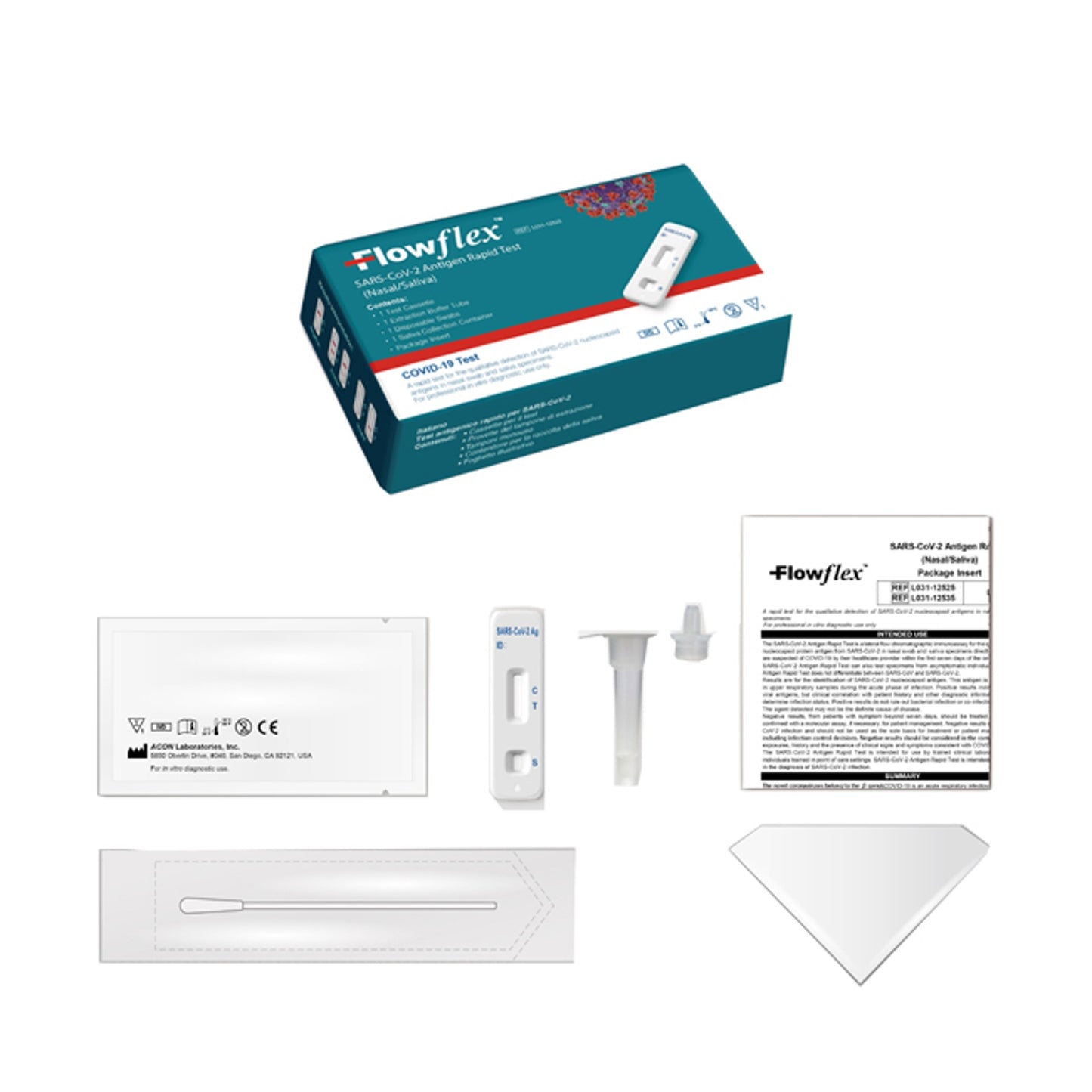
The kit contains:
- 1 test cassette;
- 1 disposable swab (made by another manufacturer);
- 1 package insert;
- 1 tube with extraction buffer solution;
- 1 saliva collection container.
Bibliography
1. Shuo Su, Gary Wong, Weifeng Shi, et al. Epidemiology, Genetic recombination, and pathogenesis of coronaviruses. Trends in Microbiology, June 2016, vol. 24, No. 6: 490-502
2. Susan R. Weiss, Julian L. Leibowitz, Coronavirus Pathogenesis, Advances in Virus Research, Volume 81: 85-164
Code. L031-12525
A lateral flow chromatographic immunoassay for the qualitative detection of SARS-CoV-2 virus nucleocapsid protein antigen, in nasal swab or saliva samples, collected directly from individuals with suspected COVID-19 infection by their physician, within the first seven days of symptom onset.
The test can be used to analyze samples from asymptomatic individuals.
It does not distinguish between SARS-CoV and SARS-CoV-2.
When extracted samples are processed and dispensed into the test cassette, SARS-CoV-2 antigens, if present in the sample, react with particles coated with anti-SARS-CoV-2 antibodies, which are present on the test line (T). The mixture then migrates through the membrane by capillary action. The conjugated antigen complexes migrate through the test strip to the reaction area and are captured by a line of bound antibodies on the membrane. Test results are interpreted visually after 15 and no later than 30 minutes based on the presence or absence of visible colored lines.
As an exclusive procedural control, a colored line always appears in the control line region (C), indicating that the correct sample volume has been added and that proper membrane wetting has occurred.
A positive result indicates the presence of SARS-CoV-2 nucleocapsid antigen. This antigen is generally detectable in upper respiratory tract samples during the acute phase of infection. As noted, positive results indicate the presence of viral antigens, but clinical correlation with patient history and other diagnostic information is necessary to determine infection status. Positive results do not rule out bacterial infections or co-infections with other viruses. The detected agent may not be the definitive cause of the disease.
Negative results, in patients with symptoms beyond seven days, should be treated as presumptive negatives and confirmed with a molecular test for proper patient management. Negative results do not rule out SARS-CoV-2 infection and should not be used as the sole reference for treatment or patient management decisions, including decisions on which to base the clinical approach to infection. Negative results should be considered in the context of the patient's recent exposures, medical history, and the presence of clinical signs and symptoms consistent with COVID-19.
The test is intended for use by trained clinical laboratory personnel and qualified healthcare professionals at care facilities.
The SARS-CoV-2 Rapid Antigen Test is intended to be used as an aid in the diagnosis of SARS-CoV-2 infection.
How to use
The test must be performed immediately after sample collection, or at most within one (1) hour of sample collection, provided it is stored at room temperature (15-30°C).
Nasal swab sample collection can be performed by a professional or by oneself, but always under the supervision of a healthcare professional.
For children under 12 years of age, sample collection must be performed by a healthcare professional.
Children aged 12 to 17 must be supervised by adults if they collect the nasal sample themselves.
Adults (18 years and older) can perform nasal sample collection independently.
Follow local guidelines for sample collection by children.
How to collect an anterior nasal sample with a swab:
Carefully insert one of the disposable nasal swabs included in the kit into one nostril. Gently rotating it, push the swab no more than 2.5 cm (1 inch) into the nose from the tip of the nostril. Swab the cotton tip of the nasal swab on the inner surface of the nostril (mucosa) with rotational movements, both clockwise and counter-clockwise, for five consecutive times. Using the same nasal swab, repeat the procedure in the other nostril to ensure that an adequate sample is collected from both nasal cavities. Remove the swab from the nasal cavity. The sample is now ready for preparation using the tubes containing the extraction buffer solution.
How to collect a saliva sample:
Do not eat, drink, smoke, chew gum, or brush your teeth 30 minutes before collecting a saliva sample.
Before collecting a saliva sample, gently massage your cheeks for 15-30 seconds. Place your tongue against the roots of your lower teeth and allow saliva to collect in that area.
Insert a disposable cotton swab (included in the KIT) into your mouth and hold it for at least 30 seconds, until the tip of the swab is completely saturated with saliva.
Alternatively, saliva can be collected by carefully spitting into the saliva collection container included in the KIT.
When using the saliva collection container to collect saliva, immerse the absorbent tip of the disposable swab into the collection container until the tip of the swab is completely saturated with saliva.
Note: False negative results may occur if the swab is not completely saturated with saliva.
Allow the sample and extraction buffer solution to reach room temperature (15-30°C) before performing the test.
Use one tube containing the extraction buffer solution for each sample to be tested and label each tube appropriately. Remove the aluminum foil from the top end of the tube containing the extraction buffer solution. Insert the swab into the tube and shake for 30 seconds. Then rotate the swab at least 5 times, squeezing the sides of the tube tightly. Be careful not to spray the contents out of the tube. Remove the swab by squeezing the sides of the tube to extract the liquid from the swab. Securely attach the dropper tip to the extraction buffer tube containing the sample. Mix thoroughly by swirling and flicking the bottom of the tube. Remove the test cassette from the foil pouch and use it as soon as possible. Place the test cassette on a clean, flat surface. Add the processed sample to the corresponding well of the test cassette. Invert the tube containing the extraction buffer solution and the sample with the dropper tip facing downwards, keeping it vertical. Gently squeeze the tube, dispensing 4 drops of the treated sample into the sample well.
Wait for colored lines to appear. The result should be read after 15-30 minutes. Do not read the result after 30 minutes.
Interpretation of results:
- NEGATIVE: Only one colored line appears in the control line region (C). No visible colored line appears in the test line region (T). This means that no SARS-CoV-2 antigen has been detected.
- POSITIVE: *Two distinct colored lines appear. One line in the control line region (C) and the other in the test line region (T). This means that SARS-CoV-2 antigen has been detected.
- INVALID: No control line appears. Insufficient sample volume or incorrect use are the most likely reasons for the control line not appearing. Review the procedure and repeat the test with a new test cassette. If the problem persists, discontinue use of the kit and contact your local distributor.
*NOTE: The color intensity of the test line (T) may vary depending on the level of SARS-CoV-2 antigen present in the sample. Therefore, any shade of color in the test line region (T) should be considered positive.
Warnings
For professional in vitro diagnostic use only. Do not use beyond the expiration date.
Do not eat, drink, or smoke in the area where samples or the kit are handled.
Do not use the test if the outer wrapper is damaged.
Handle all samples as if they contain infectious agents. Observe established precautions against biological hazards during testing and follow standard procedures for proper sample disposal.
Wear protective clothing, e.g., lab coats, disposable gloves, masks, and eye protection when testing samples.
The used test should be considered potentially infectious and disposed of in accordance with local regulations.
Humidity and temperature can adversely affect results.
Read the package insert carefully before performing the test. Failure to follow the instructions specified in the package insert may result in inaccurate test results.
The test line for a sample with a high viral load may become visible within 15 minutes, or as soon as the sample passes the test line area.
The test line for a sample with a low viral load becomes visible after 30 minutes.
The SARS-CoV-2 rapid antigen test is for in vitro diagnostic use only. The test should be used for the detection of SARS-CoV-2 virus antigens in nasal swab or saliva samples. The intensity of the test line is not necessarily related to the SARS-CoV-2 viral titer present in the sample. Note that the viral load in the saliva sample is relatively low, so a nasal sample is recommended. If nasal sampling is not possible, a saliva sample can be used.
Samples should be tested as quickly as possible after sample collection and at most within one hour after collection.
The use of preservation and stabilization media for sample transport may result in a reduction in test sensitivity.
A false negative test may be obtained if the antigen concentration in a sample is below the detection limit of the test or if the sample was collected incorrectly.
Test results should be correlated with other clinical data available to the physician.
A positive test result does not rule out co-infections with other pathogens.
A positive test result does not distinguish between SARS-CoV and SARS-CoV-2. A negative test result is not intended to rule out other viral or bacterial infections. A negative result, in a patient with symptom onset beyond seven days, should be treated as presumptive negative and confirmed with a molecular test, based on which clinical treatment will be established (if differentiation of specific SARS viruses and strains is necessary, further testing should be performed.)
Storage
The kit can be stored at temperatures between 2-30°C. Do not freeze.
The test is stable until the expiration date printed on the sealed outer wrapper. Do not use beyond the expiration date.
The test must remain in the sealed wrapper until use.
Shelf life when unopened: 24 months.
Format
The kit contains:
- 1 test cassette;
- 1 disposable swab (made by another manufacturer);
- 1 package insert;
- 1 tube with extraction buffer solution;
- 1 saliva collection container.
Bibliography
1. Shuo Su, Gary Wong, Weifeng Shi, et al. Epidemiology, Genetic recombination, and pathogenesis of coronaviruses. Trends in Microbiology, June 2016, vol. 24, No. 6: 490-502
2. Susan R. Weiss, Julian L. Leibowitz, Coronavirus Pathogenesis, Advances in Virus Research, Volume 81: 85-164
Code. L031-12525
Share