1
/
of
1
MY BENEFIT SRL
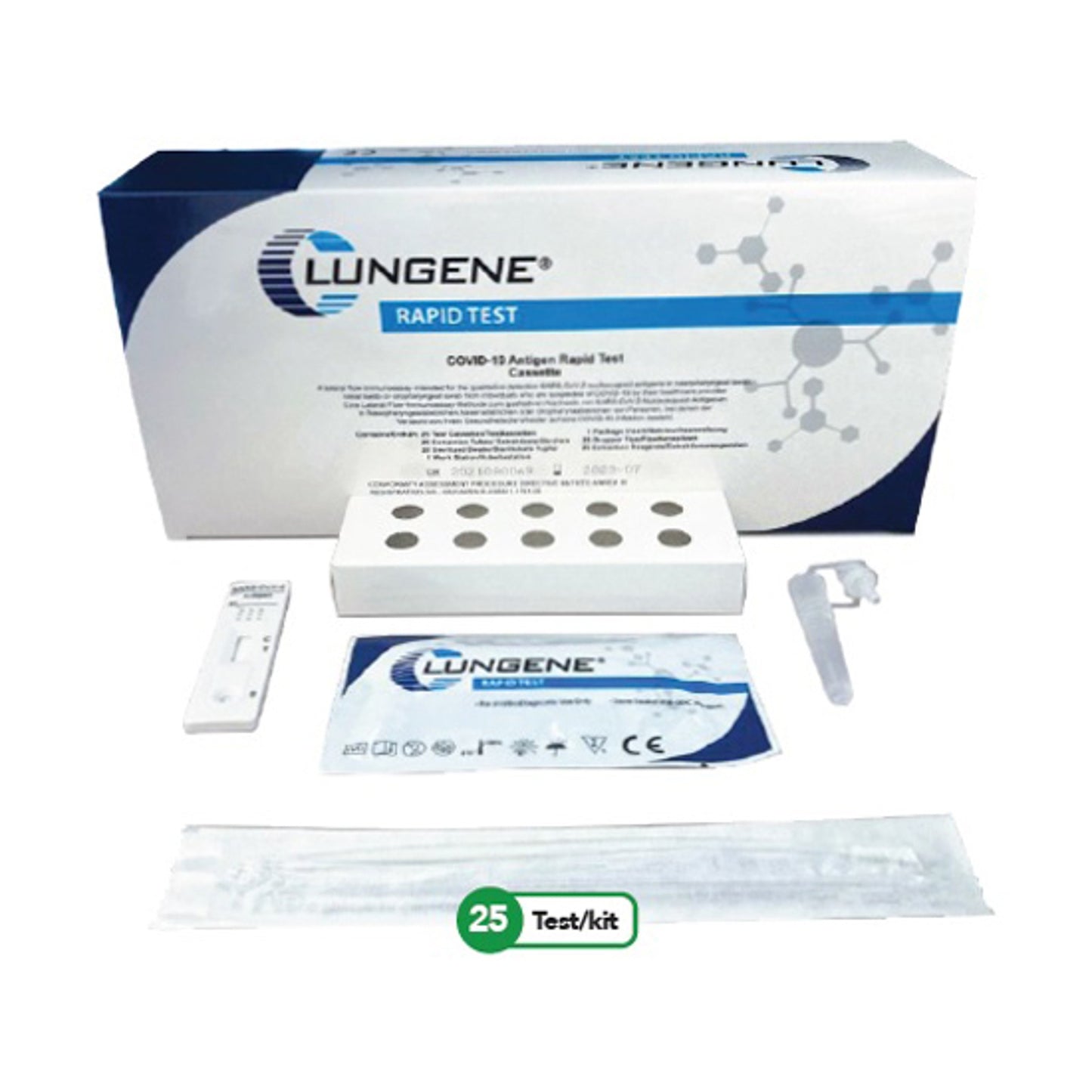
Clungene COVID-19 Rapid Antigen Test Qualitative Determination of SARS-CoV-2 Antigens in Nasopharyngeal/Oropharyngeal Swabs by Immunochromatography 25 Pieces For Professional Use
Clungene COVID-19 Rapid Antigen Test Qualitative Determination of SARS-CoV-2 Antigens in Nasopharyngeal/Oropharyngeal Swabs by Immunochromatography 25 Pieces For Professional Use
Regular price
€0,00 EUR
Regular price
Sale price
€0,00 EUR
Taxes included.
Shipping calculated at checkout.
Quantity
Couldn't load pickup availability
MINSAN: 983320286
EAN:
DITTA: MY BENEFIT SRL
CLUNGENE
COVID-19 Antigen Rapid Test Cassette
FOR PROFESSIONAL USE
Description
A lateral flow immunoassay for the qualitative detection of SARS-CoV-2 nucleocapsid antigen in nasopharyngeal and oropharyngeal swabs from individuals suspected of being infected with COVID-19.
Results are for the detection of SARS-CoV-2 nucleocapsid antigen. Antigen is generally detectable in nasopharyngeal and oropharyngeal swabs during the acute phase of infection.
Rapid COVID-19 antigen detection is based on a lateral flow immunoassay using the principle of double antibody sandwich technology. SARS-CoV-2 nucleocapsid protein monoclonal antibody conjugated to colored microparticles is used as a detector and sprayed onto the conjugate pad.
During the test, SARS-CoV-2 antigen in the sample interacts with the conjugated SARS-CoV-2 antibody to color the microparticles, forming an antigen-antibody complex labeled with the antigen. This complex migrates by capillary action on the membrane towards the test line where it is captured by the pre-coated SARS-CoV-2 nucleocapsid protein monoclonal antibody.
A colored test line (T) would be visible in the results window if SARS-CoV-2 antigens were present in the sample.
The absence of the T line indicates a negative result.
The control line (C) is used as a procedural control and should always be displayed when the test procedure is performed correctly.
Positive results indicate the presence of viral antigen, but clinical detection, patient clinical history, and other diagnostic information are needed to determine infection status. Positive results do not rule out the possibility of bacterial infection or co-infection with other viruses. The identified pathogen may not be the sole cause of the disease.
Negative results do not rule out SARS-CoV-2 infection and should not be used as the sole basis for treatment or patient management decisions, including infection control decisions. Negative results should be considered in the context of the patient's recent exposure history, medical history, and the presence of clinical signs and symptoms consistent with COVID-19 and, if necessary, confirmed by a molecular test for patient management.
The test is intended for use by trained clinical laboratory personnel who have been specifically instructed and studied for the in vitro diagnostic procedure.
Instructions for use
Examination:
Samples obtained early in the onset of symptoms contain higher viral titers; samples obtained after 5 days of symptoms are more likely to yield negative results compared to an RT-PCR assay.
Inadequate sample collection, improper sample handling and/or transport can lead to false results. Therefore, training in sample collection is highly recommended, as sample quality is essential for accurate and reliable results.
The acceptable sample type for testing is a direct swab or a swab in viral transport media (VTM) without denaturant.
Prepare the extraction tube according to the test procedure and use the sterile swab provided in the kit to collect the sample.
- Nasopharyngeal swab sample collection: Remove the swab from its packaging. Tilt the patient's head back approximately 70°. Insert the swab through the nostril, parallel to the palate (not upwards) until resistance is met or the distance is equal to that from the patient's ear to nostril, indicating contact with the nasopharynx (the swab should reach a depth corresponding to the distance between the nostrils and the external ear opening). Gently rub and rotate the swab. Leave the swab in place for a few seconds to absorb secretions. Slowly remove the swab while rotating it. Samples can be collected from both sides with the same swab.
However, it is not necessary to collect samples from both sides when the mini-tip of the swab is saturated with fluid from the first collection.
If a deviated nasal septum or blockage causes difficulty in obtaining the sample from one nostril, use the same swab to obtain the sample from the other nostril.
- Nasal swab sample collection: Insert the swab approximately 2.5 cm into the nostril, rotating it slightly until resistance is felt at the turbinates. Turn the swab several times against the nasal wall and repeat the procedure in the other nostril with the same swab.
- Oropharyngeal swab sample collection: Insert the swab into the posterior pharyngeal and tonsillar area. Swab both tonsils and the posterior oropharynx and avoid touching the tongue, teeth, or gums.
Sample transport and storage:
Do not return the swab to its original packaging.
Newly collected samples should be processed as soon as possible and no later than one hour after collection. Samples should not be stored between 2-8 °C for more than 24 hours. Store them at -70 °C for a long period of time. However, avoid repeated freeze-thaw cycles.
Test performance:
Before performing the test, allow test devices, reagents, and samples to equilibrate to room temperature (15-30 °C or 59-86 °F).
Place an extraction tube on the workstation. Add 0.3 ml (10 drops) of extraction reagent into the extraction tube.
- Direct swab test method: Insert the swab with the sample into the extraction tube containing the extraction reagent. Rotate the swab at least five times while pressing the swab head against the bottom and side of the extraction tube. Leave the swab in the extraction tube for a few minutes.
Remove the swab while compressing the sides of the tube to extract the liquid from the swab. The extracted solution is used as the test sample. Close the extraction tube tightly with the dropper tip.
Remove the device from the sealed pouch. Invert the sample collection tube and hold it vertically. Slowly add approximately 100 µL to the sample well S of the test device and start the timer.
Wait for the colored lines to appear. Read the test results after 15 minutes. After more than twenty minutes, the results should be considered invalid.
- Test method with swabs in viral transport media (VTM): Insert the swab with the sample into the transport tube containing a maximum of 3 ml of VTM without denaturing agent. Mix the stored sample by rotating it. Transfer 300 µL of the sample-containing solution with a calibrated micropipette into the extraction tube containing the extraction reagent. Homogenize the mixture by pipetting up and down. Tightly cover the extraction tube with a dropper tip and let the extracted solution stand for one minute.
Remove the device from the sealed pouch. Invert the sample collection tube and hold it vertically. Slowly add approximately 100 µL to the sample well S of the test device and start the timer.
Wait for the colored lines to appear. Read the test results after 15 minutes. After more than twenty minutes, the results should be considered invalid.
Results:
Positive: two lines appear. A colored line appears in the control region (C) and another colored line appears in the test region (T). The color intensity of the test line (T) is irrelevant.
Negative: a colored line appears in the control region (C) and no line appears in the test region (T).
Invalid: the control line is not displayed. Insufficient sample volume or incorrect procedural techniques are the most likely reasons for the absence of the control line. Review the procedure and repeat the test with a new detection kit. If the problem persists, discontinue use of the kit immediately and contact your local distributor.
Warnings
For in vitro diagnostic use only, for healthcare professionals.
Do not use this test as the sole basis for diagnosing or excluding COVID-19 infection.
Do not use the kit after the expiration date.
Please read all information in the package insert before performing the test.
The cassette must be stored in the sealed pouch before use.
All samples should be classified as potentially hazardous and treated as infectious agents.
The used kit must be disposed of in accordance with federal, state, and local regulations.
The test provides a qualitative result. The intensity of the test line (T) is not correlated with the concentration of antigens in the samples.
Negative results do not rule out SARS-CoV-2 infection and should not be used as the sole basis for patient management decisions.
The physician should interpret the results in combination with the patient's medical history, physical findings, and other diagnostic procedures.
A negative result may occur if the amount of antigens present in the sample is below the detection threshold or if the virus has undergone one or more minor amino acid mutations in the target epitope region recognized by the monoclonal antibodies used in the test.
Storage
Store in the sealed pouch at a temperature between 4 °C and 30 °C.
After opening the pouch, the test must be performed within one hour. Prolonged contact with hot and humid environments causes product deterioration.
The kit is stable until the expiration date indicated on the label.
Shelf life when unopened: 24 months.
Format
Contains:
- 25 detection kits: 1 cassette with desiccant in a single pouch;
- reagent;
- 25 sterilized swabs (disposable swabs for sample collection);
- 25 extraction tubes;
- 25 tips;
- 1 workstation;
- 1 instruction manual.
Code COV19AG
A lateral flow immunoassay for the qualitative detection of SARS-CoV-2 nucleocapsid antigen in nasopharyngeal and oropharyngeal swabs from individuals suspected of being infected with COVID-19.
Results are for the detection of SARS-CoV-2 nucleocapsid antigen. Antigen is generally detectable in nasopharyngeal and oropharyngeal swabs during the acute phase of infection.
Rapid COVID-19 antigen detection is based on a lateral flow immunoassay using the principle of double antibody sandwich technology. SARS-CoV-2 nucleocapsid protein monoclonal antibody conjugated to colored microparticles is used as a detector and sprayed onto the conjugate pad.
During the test, SARS-CoV-2 antigen in the sample interacts with the conjugated SARS-CoV-2 antibody to color the microparticles, forming an antigen-antibody complex labeled with the antigen. This complex migrates by capillary action on the membrane towards the test line where it is captured by the pre-coated SARS-CoV-2 nucleocapsid protein monoclonal antibody.
A colored test line (T) would be visible in the results window if SARS-CoV-2 antigens were present in the sample.
The absence of the T line indicates a negative result.
The control line (C) is used as a procedural control and should always be displayed when the test procedure is performed correctly.
Positive results indicate the presence of viral antigen, but clinical detection, patient clinical history, and other diagnostic information are needed to determine infection status. Positive results do not rule out the possibility of bacterial infection or co-infection with other viruses. The identified pathogen may not be the sole cause of the disease.
Negative results do not rule out SARS-CoV-2 infection and should not be used as the sole basis for treatment or patient management decisions, including infection control decisions. Negative results should be considered in the context of the patient's recent exposure history, medical history, and the presence of clinical signs and symptoms consistent with COVID-19 and, if necessary, confirmed by a molecular test for patient management.
The test is intended for use by trained clinical laboratory personnel who have been specifically instructed and studied for the in vitro diagnostic procedure.
Instructions for use
Examination:
Samples obtained early in the onset of symptoms contain higher viral titers; samples obtained after 5 days of symptoms are more likely to yield negative results compared to an RT-PCR assay.
Inadequate sample collection, improper sample handling and/or transport can lead to false results. Therefore, training in sample collection is highly recommended, as sample quality is essential for accurate and reliable results.
The acceptable sample type for testing is a direct swab or a swab in viral transport media (VTM) without denaturant.
Prepare the extraction tube according to the test procedure and use the sterile swab provided in the kit to collect the sample.
- Nasopharyngeal swab sample collection: Remove the swab from its packaging. Tilt the patient's head back approximately 70°. Insert the swab through the nostril, parallel to the palate (not upwards) until resistance is met or the distance is equal to that from the patient's ear to nostril, indicating contact with the nasopharynx (the swab should reach a depth corresponding to the distance between the nostrils and the external ear opening). Gently rub and rotate the swab. Leave the swab in place for a few seconds to absorb secretions. Slowly remove the swab while rotating it. Samples can be collected from both sides with the same swab.
However, it is not necessary to collect samples from both sides when the mini-tip of the swab is saturated with fluid from the first collection.
If a deviated nasal septum or blockage causes difficulty in obtaining the sample from one nostril, use the same swab to obtain the sample from the other nostril.
- Nasal swab sample collection: Insert the swab approximately 2.5 cm into the nostril, rotating it slightly until resistance is felt at the turbinates. Turn the swab several times against the nasal wall and repeat the procedure in the other nostril with the same swab.
- Oropharyngeal swab sample collection: Insert the swab into the posterior pharyngeal and tonsillar area. Swab both tonsils and the posterior oropharynx and avoid touching the tongue, teeth, or gums.
Sample transport and storage:
Do not return the swab to its original packaging.
Newly collected samples should be processed as soon as possible and no later than one hour after collection. Samples should not be stored between 2-8 °C for more than 24 hours. Store them at -70 °C for a long period of time. However, avoid repeated freeze-thaw cycles.
Test performance:
Before performing the test, allow test devices, reagents, and samples to equilibrate to room temperature (15-30 °C or 59-86 °F).
Place an extraction tube on the workstation. Add 0.3 ml (10 drops) of extraction reagent into the extraction tube.
- Direct swab test method: Insert the swab with the sample into the extraction tube containing the extraction reagent. Rotate the swab at least five times while pressing the swab head against the bottom and side of the extraction tube. Leave the swab in the extraction tube for a few minutes.
Remove the swab while compressing the sides of the tube to extract the liquid from the swab. The extracted solution is used as the test sample. Close the extraction tube tightly with the dropper tip.
Remove the device from the sealed pouch. Invert the sample collection tube and hold it vertically. Slowly add approximately 100 µL to the sample well S of the test device and start the timer.
Wait for the colored lines to appear. Read the test results after 15 minutes. After more than twenty minutes, the results should be considered invalid.
- Test method with swabs in viral transport media (VTM): Insert the swab with the sample into the transport tube containing a maximum of 3 ml of VTM without denaturing agent. Mix the stored sample by rotating it. Transfer 300 µL of the sample-containing solution with a calibrated micropipette into the extraction tube containing the extraction reagent. Homogenize the mixture by pipetting up and down. Tightly cover the extraction tube with a dropper tip and let the extracted solution stand for one minute.
Remove the device from the sealed pouch. Invert the sample collection tube and hold it vertically. Slowly add approximately 100 µL to the sample well S of the test device and start the timer.
Wait for the colored lines to appear. Read the test results after 15 minutes. After more than twenty minutes, the results should be considered invalid.
Results:
Positive: two lines appear. A colored line appears in the control region (C) and another colored line appears in the test region (T). The color intensity of the test line (T) is irrelevant.
Negative: a colored line appears in the control region (C) and no line appears in the test region (T).
Invalid: the control line is not displayed. Insufficient sample volume or incorrect procedural techniques are the most likely reasons for the absence of the control line. Review the procedure and repeat the test with a new detection kit. If the problem persists, discontinue use of the kit immediately and contact your local distributor.
Warnings
For in vitro diagnostic use only, for healthcare professionals.
Do not use this test as the sole basis for diagnosing or excluding COVID-19 infection.
Do not use the kit after the expiration date.
Please read all information in the package insert before performing the test.
The cassette must be stored in the sealed pouch before use.
All samples should be classified as potentially hazardous and treated as infectious agents.
The used kit must be disposed of in accordance with federal, state, and local regulations.
The test provides a qualitative result. The intensity of the test line (T) is not correlated with the concentration of antigens in the samples.
Negative results do not rule out SARS-CoV-2 infection and should not be used as the sole basis for patient management decisions.
The physician should interpret the results in combination with the patient's medical history, physical findings, and other diagnostic procedures.
A negative result may occur if the amount of antigens present in the sample is below the detection threshold or if the virus has undergone one or more minor amino acid mutations in the target epitope region recognized by the monoclonal antibodies used in the test.
Storage
Store in the sealed pouch at a temperature between 4 °C and 30 °C.
After opening the pouch, the test must be performed within one hour. Prolonged contact with hot and humid environments causes product deterioration.
The kit is stable until the expiration date indicated on the label.
Shelf life when unopened: 24 months.
Format
Contains:
- 25 detection kits: 1 cassette with desiccant in a single pouch;
- reagent;
- 25 sterilized swabs (disposable swabs for sample collection);
- 25 extraction tubes;
- 25 tips;
- 1 workstation;
- 1 instruction manual.
Code COV19AG
Share