1
/
of
1
GIMA SPA
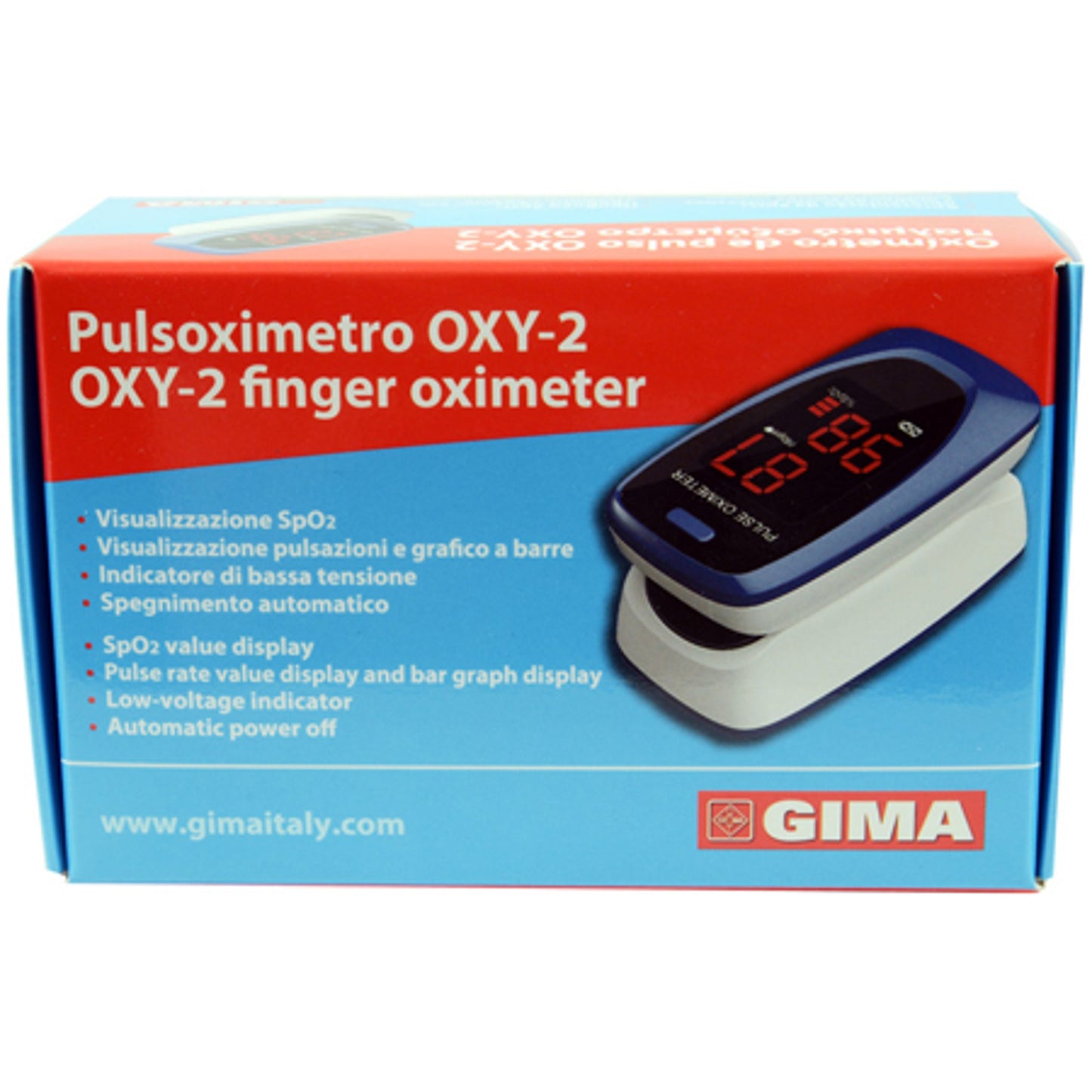
Oxy-2 Finger Pulse Oximeter LED Screen 60X30.5X32.5Mm 1 Piece
Oxy-2 Finger Pulse Oximeter LED Screen 60X30.5X32.5Mm 1 Piece
Regular price
€19,90 EUR
Regular price
€35,00 EUR
Sale price
€19,90 EUR
Taxes included.
Shipping calculated at checkout.
Quantity
Couldn't load pickup availability
MINSAN: 973923081
EAN: 8023279350722
DITTA: GIMA SPA
PULSE OXIMETER OXY-2
Description
The Fingertip Pulse Oximeter is a non-invasive device designed for instantaneous monitoring of arterial hemoglobin saturation (SpO2) and heart rate in adults and children in home and hospital environments (including clinical use in internal/surgical therapy, anesthesia and intensive care, etc.).
It is not intended for continuous monitoring.
It is compact, convenient to use and carry, and has low power consumption. The two AAA batteries supplied can be used continuously for 24 hours.
Automatic shutdown when no signal is received within 5 seconds.
Low battery indicator as a flashing battery icon.
The patient simply inserts their fingertip into the device's photoelectric sensor and the Hemoglobin Saturation value immediately appears on the screen.
Technical specifications:
- Display format: Digital tube display;
- Screen type: LED;
- SpO2 measurement range: 0%-100%;
- Heart rate measurement range: 30 bpm - 250 bpm;
- Heart rate intensity display: Bar display;
- Power requirements: 2 x 1.5 V AAA alkaline batteries; adaptable range: 2.6 V - 3.6 V;
- Supply current: less than 25 mA;
- Resolution: 1% for SpO2 and 1 bpm for heart rate;
- Measurement accuracy: ±2% in the 70%-100% SpO2 range, and irrelevant when the range is less than 70%. ±2 bpm or ±2% (select the larger) for heart rate;
- Measurement performance in the presence of weak filling pressure: SpO2 and heart rate are correctly displayed when the heart rate-filling ratio is 0.4%. SpO2 error ±4%, heart rate error ±2 bpm or ±2% (select the larger);
- Tolerance to external light: The difference between the value detected in the presence of artificial light, natural indoor light, and that of a dark room is less than ±1%;
- It has a function switch. The Pulse Oximeter turns off if it does not detect fingers in the device;
- Optical sensor: red light (wavelength is 660 nm, 6.65 mW) and infrared (wavelength is 880 nm, 6.75 mW);
- Operating environment:
Temperature: 10°C - 40°C
Relative humidity: ≤75%
Atmospheric pressure: 700 hPa - 1,060 hPa.
Note: The optical sensor is a light-emitting component that affects other medical devices by applying the same range of wavelengths.
Instructions for use
Insert the two batteries in the correct direction and then replace the cover. Open the sensor. Have the patient insert their finger into the rubber-lined sensor (make sure the finger is in the correct position), then allow the sensor to close on the finger. Press the power button on the front panel. Do not move the finger and keep the patient at rest during measurement. In addition, it is recommended that the patient does not move. Measurement results are displayed directly on the display.
When the recorder is in startup mode, press the button and the device is reset.
The nails and the luminescent tube must remain on the same side.
Cleaning and maintenance: Replace batteries when the low battery indicator starts flashing.
Clean the device surface before use. Wipe with medical alcohol first and then allow to air dry or wipe dry.
Use medical alcohol to disinfect the product after use to prevent contamination for subsequent use.
If the Pulse Oximeter is not used for a long period, remove the batteries.
The device must be calibrated regularly (or according to the hospital's calibration schedule).
Do not sterilize the device with high pressure.
Warnings
The finger must be positioned appropriately, otherwise this may cause inaccurate measurements.
The SpO2 sensor and the photoelectric receiving tube must be arranged so that the patient's arteriole is in a position between the two.
The SpO2 sensor should not be used on a site or limb tied with a blood pressure cuff or during an intravenous injection.
Make sure the optical path is clear of optical obstructions, such as rubberized fabric.
Excessive ambient light can affect the measurement result. This includes fluorescent lamps, double red lights, infrared radiators, direct sunlight, etc.
Strenuous patient action or extreme electro-surgical interference can also affect accuracy.
The patient undergoing the examination cannot wear nail polish or other cosmetics.
Do not immerse the device in any type of liquid.
It is recommended to keep the device in a dry environment. Humidity could reduce the device's life cycle or even damage it.
Explosion hazard: do not use the Pulse Oximeter in environments with flammable gases such as some flammable anesthetic agents.
DO NOT use the Pulse Oximeter while the patient is undergoing MRI or CT scans.
a person allergic to rubber cannot use this device.> Please check the packaging before use to ensure that the device and its accessories fully comply with the packing list, otherwise the device may malfunction.
Please do not measure this device with paper functional tests for relevant device information.
Keep the Pulse Oximeter away from dust, vibrations, corrosive substances, explosive materials, high temperatures and humidity.
If the Pulse Oximeter gets wet, please stop using it.
When transported from a cold environment to a warm or humid environment, do not use it immediately.
DO NOT press the front panel buttons with sharp objects.
Disinfection of the Pulse Oximeter with high-temperature steam or pressure is not allowed. Do not immerse the Pulse Oximeter in liquids. When cleaning is required, wipe its surface with a soft cloth moistened with medical alcohol. Do not spray liquids directly on the device. When cleaning the device with water, the temperature must be below 60°C.
Since fingers that are too thin or too cold could affect the normal SpO2 and heart rate measurement of the patient, position thicker fingers, such as the thumb and middle finger, deep enough into the device.
Do not use the device on infants or newborns. The device is suitable for children over four years old and adults (weight must be between 15 and 110 kg).
The device may not work for all patients. If you are unable to achieve stable measurements, discontinue use.
The data update period is less than 5 seconds: this duration varies based on different individual heart rates.
If any abnormality appears on the screen during the testing procedure, remove the finger and reinsert it to restore normal use.
The normal life cycle of the device is three years from the first power-on.
The support lanyard attached to the product is made of hypoallergenic material; if a particular group is allergic to the support lanyard, stop using it. In addition, pay attention to the use of the support lanyard, do not hang it around the neck to avoid injury to the patient.
The device does not have a low voltage alarm function, it only indicates the battery charge level. Please change the battery when the energy level is exhausted.
The device does not have an alarm function for particularly low parameters. Do not use the device in situations where alarms are required.
Batteries must be removed if the device is stored for more than one month, otherwise they may leak.
A flexible circuit connects the two parts of the device. Do not twist or pull the connection.
Storage
Store between -40°C and 60°C. Relative humidity: ≤95%
Format
1 piece.
Code. 35072
The Fingertip Pulse Oximeter is a non-invasive device designed for instantaneous monitoring of arterial hemoglobin saturation (SpO2) and heart rate in adults and children in home and hospital environments (including clinical use in internal/surgical therapy, anesthesia and intensive care, etc.).
It is not intended for continuous monitoring.
It is compact, convenient to use and carry, and has low power consumption. The two AAA batteries supplied can be used continuously for 24 hours.
Automatic shutdown when no signal is received within 5 seconds.
Low battery indicator as a flashing battery icon.
The patient simply inserts their fingertip into the device's photoelectric sensor and the Hemoglobin Saturation value immediately appears on the screen.
Technical specifications:
- Display format: Digital tube display;
- Screen type: LED;
- SpO2 measurement range: 0%-100%;
- Heart rate measurement range: 30 bpm - 250 bpm;
- Heart rate intensity display: Bar display;
- Power requirements: 2 x 1.5 V AAA alkaline batteries; adaptable range: 2.6 V - 3.6 V;
- Supply current: less than 25 mA;
- Resolution: 1% for SpO2 and 1 bpm for heart rate;
- Measurement accuracy: ±2% in the 70%-100% SpO2 range, and irrelevant when the range is less than 70%. ±2 bpm or ±2% (select the larger) for heart rate;
- Measurement performance in the presence of weak filling pressure: SpO2 and heart rate are correctly displayed when the heart rate-filling ratio is 0.4%. SpO2 error ±4%, heart rate error ±2 bpm or ±2% (select the larger);
- Tolerance to external light: The difference between the value detected in the presence of artificial light, natural indoor light, and that of a dark room is less than ±1%;
- It has a function switch. The Pulse Oximeter turns off if it does not detect fingers in the device;
- Optical sensor: red light (wavelength is 660 nm, 6.65 mW) and infrared (wavelength is 880 nm, 6.75 mW);
- Operating environment:
Temperature: 10°C - 40°C
Relative humidity: ≤75%
Atmospheric pressure: 700 hPa - 1,060 hPa.
Note: The optical sensor is a light-emitting component that affects other medical devices by applying the same range of wavelengths.
Instructions for use
Insert the two batteries in the correct direction and then replace the cover. Open the sensor. Have the patient insert their finger into the rubber-lined sensor (make sure the finger is in the correct position), then allow the sensor to close on the finger. Press the power button on the front panel. Do not move the finger and keep the patient at rest during measurement. In addition, it is recommended that the patient does not move. Measurement results are displayed directly on the display.
When the recorder is in startup mode, press the button and the device is reset.
The nails and the luminescent tube must remain on the same side.
Cleaning and maintenance: Replace batteries when the low battery indicator starts flashing.
Clean the device surface before use. Wipe with medical alcohol first and then allow to air dry or wipe dry.
Use medical alcohol to disinfect the product after use to prevent contamination for subsequent use.
If the Pulse Oximeter is not used for a long period, remove the batteries.
The device must be calibrated regularly (or according to the hospital's calibration schedule).
Do not sterilize the device with high pressure.
Warnings
The finger must be positioned appropriately, otherwise this may cause inaccurate measurements.
The SpO2 sensor and the photoelectric receiving tube must be arranged so that the patient's arteriole is in a position between the two.
The SpO2 sensor should not be used on a site or limb tied with a blood pressure cuff or during an intravenous injection.
Make sure the optical path is clear of optical obstructions, such as rubberized fabric.
Excessive ambient light can affect the measurement result. This includes fluorescent lamps, double red lights, infrared radiators, direct sunlight, etc.
Strenuous patient action or extreme electro-surgical interference can also affect accuracy.
The patient undergoing the examination cannot wear nail polish or other cosmetics.
Do not immerse the device in any type of liquid.
It is recommended to keep the device in a dry environment. Humidity could reduce the device's life cycle or even damage it.
Explosion hazard: do not use the Pulse Oximeter in environments with flammable gases such as some flammable anesthetic agents.
DO NOT use the Pulse Oximeter while the patient is undergoing MRI or CT scans.
a person allergic to rubber cannot use this device.> Please check the packaging before use to ensure that the device and its accessories fully comply with the packing list, otherwise the device may malfunction.
Please do not measure this device with paper functional tests for relevant device information.
Keep the Pulse Oximeter away from dust, vibrations, corrosive substances, explosive materials, high temperatures and humidity.
If the Pulse Oximeter gets wet, please stop using it.
When transported from a cold environment to a warm or humid environment, do not use it immediately.
DO NOT press the front panel buttons with sharp objects.
Disinfection of the Pulse Oximeter with high-temperature steam or pressure is not allowed. Do not immerse the Pulse Oximeter in liquids. When cleaning is required, wipe its surface with a soft cloth moistened with medical alcohol. Do not spray liquids directly on the device. When cleaning the device with water, the temperature must be below 60°C.
Since fingers that are too thin or too cold could affect the normal SpO2 and heart rate measurement of the patient, position thicker fingers, such as the thumb and middle finger, deep enough into the device.
Do not use the device on infants or newborns. The device is suitable for children over four years old and adults (weight must be between 15 and 110 kg).
The device may not work for all patients. If you are unable to achieve stable measurements, discontinue use.
The data update period is less than 5 seconds: this duration varies based on different individual heart rates.
If any abnormality appears on the screen during the testing procedure, remove the finger and reinsert it to restore normal use.
The normal life cycle of the device is three years from the first power-on.
The support lanyard attached to the product is made of hypoallergenic material; if a particular group is allergic to the support lanyard, stop using it. In addition, pay attention to the use of the support lanyard, do not hang it around the neck to avoid injury to the patient.
The device does not have a low voltage alarm function, it only indicates the battery charge level. Please change the battery when the energy level is exhausted.
The device does not have an alarm function for particularly low parameters. Do not use the device in situations where alarms are required.
Batteries must be removed if the device is stored for more than one month, otherwise they may leak.
A flexible circuit connects the two parts of the device. Do not twist or pull the connection.
Storage
Store between -40°C and 60°C. Relative humidity: ≤95%
Format
1 piece.
Code. 35072
Share